The Role of Peer Review in Islamic Academic Publishing

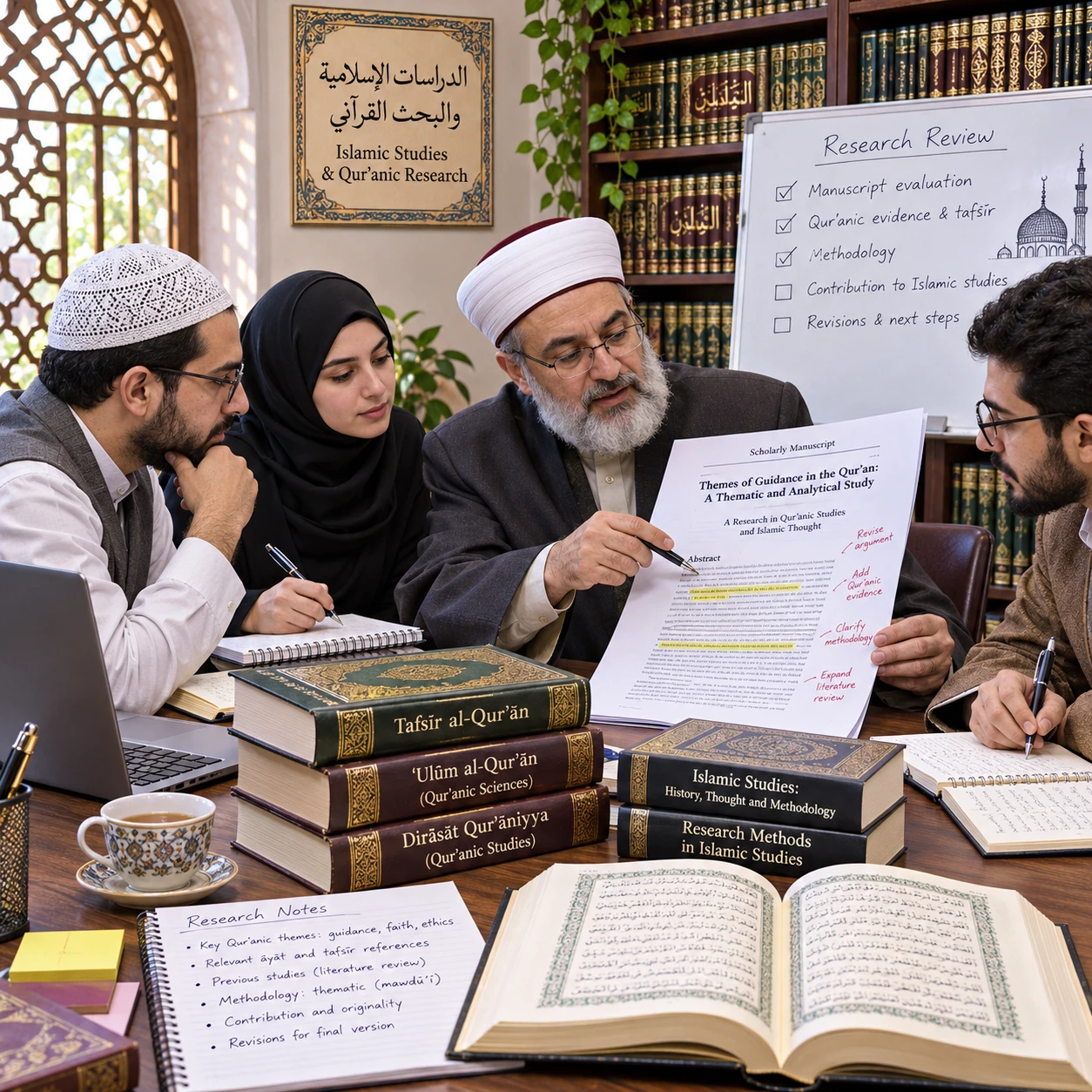
Peer review is a central quality-control practice in Islamic academic publishing. It gives researchers in Islamic studies and Qur’anic research informed feedback before a scholarly journal decides whether to publish a manuscript. Review cannot settle every interpretive question or guarantee that a conclusion is correct. Done carefully, however, it can strengthen an article’s evidence, methods, clarity, and contribution to scholarly discussion.
What peer review means in academic publishing
Peer review is the assessment of a submitted manuscript by scholars with relevant expertise before a journal makes an editorial decision. It helps a journal evaluate whether the research is sufficiently rigorous, relevant, and clearly presented for publication.
In Islamic academic publishing, peer review connects an author’s work with informed scrutiny from others in the field. Reviewers may examine research on Qur’anic interpretation, Islamic history, law, theology, ethics, manuscripts, or contemporary Muslim societies. The appropriate expertise depends on the article’s subject and approach.
The process is one part of scholarly quality control, alongside editorial screening, fact-checking where needed, and the author’s own responsibility for accurate research. Reviewers advise; the editorial board or editor makes the publication decision. Depending on the journal, review may be single-anonymous, double-anonymous, or open, with different levels of identifying information shared between authors and reviewers.
Peer review is a reasoned assessment, not a certification of truth. It can identify gaps, challenge unsupported claims, and improve how an argument is communicated. It cannot remove every error, eliminate disagreement, or replace later scrutiny by readers and researchers.
How the peer-review process works
A typical peer-review process moves from an initial editorial check to expert assessment, revision, and an editorial decision. The exact stages and timelines vary by scholarly journal, so authors should consult the journal’s stated policies.
- Submission and initial screening: The author submits the manuscript and required information. An editor checks fit with the journal’s scope, basic presentation, and submission requirements. A manuscript may be declined at this stage if it falls outside the journal’s remit or is not ready for review.
- Reviewer selection: The editor invites reviewers whose knowledge matches the manuscript’s subject and research methodology. A paper on Qur’anic readings, for example, may call for different expertise from a study of modern Islamic education.
- Reviewer assessment: Reviewers evaluate the argument, evidence, methods, engagement with scholarship, and clarity. They provide comments to the editor and, usually, feedback for the author.
- Editorial decision: The editor considers the reviews and makes a decision, such as accept, request revisions, or decline. Reviewer recommendations inform this decision but do not automatically determine it.
- Revision and follow-up: Authors respond to comments and revise the manuscript when invited. The editor may consult the original reviewers again, especially if substantial changes are needed, before reaching a final decision.
Authors can make this process more useful by submitting a focused manuscript, explaining their methods, and answering reviewer comments point by point. A response should state where a change was made or give a respectful reason for not adopting a suggestion. Reviewers, in turn, should distinguish essential concerns from optional improvements.
What reviewers assess in Islamic studies and Qur’anic research
Reviewers assess whether an Islamic studies or Qur’anic research manuscript asks a clear question, uses suitable methods, supports its claims with evidence, and engages relevant scholarship. They should judge the work in relation to its stated aims rather than expect every study to use the same approach.
Originality and contribution matter: does the article offer a new argument, interpretation, source analysis, or synthesis? A contribution need not overturn established scholarship. It may clarify a neglected question, compare sources carefully, or show why a familiar interpretation deserves reconsideration.
Reviewers also examine the fit between the research question and its research methodology. Depending on the project, this may involve close textual analysis, historical contextualization, manuscript study, ethnography, interviews, legal analysis, or another method. They may ask whether the author explains the choice of sources, defines key terms, and acknowledges limitations.
Evidence and interpretation receive close attention. In Qur’anic research, reviewers may consider how the author handles the Qur’anic text, translations, tafsir, variant readings, historical materials, or relevant linguistic evidence. In other areas of Islamic studies, the evidence might include legal texts, archival records, oral accounts, or contemporary data. Reviewers should check whether sources are represented accurately and whether the conclusions follow from them.
Finally, reviewers look at engagement with relevant scholarship and the presentation of the argument. Does the article recognize significant discussions, including disagreements across traditions or disciplines? Are citations sufficiently precise for readers to trace the evidence? A useful review identifies specific weaknesses rather than treating differences in scholarly perspective as proof of poor work.
Why peer review matters for Islamic scholarship
Peer review matters because it can improve the reliability, clarity, and scholarly value of Islamic research before publication. It gives authors informed criticism and helps editors decide whether a manuscript meets the journal’s academic standards.
In a field with diverse sources, languages, interpretive traditions, and research methods, a well-matched reviewer can notice problems that a general editorial check might miss. A reviewer might flag a translation that changes the force of an argument, point out that a historical claim needs stronger evidence, or suggest a more precise account of an interpretive debate. Authors can then revise the article or explain why they retain their approach.
That exchange supports academic integrity by encouraging clear sourcing, careful reasoning, and transparent treatment of evidence. It also helps readers understand what an article does and does not claim. A published paper that acknowledges its limits is easier to assess and build on than one that presents uncertain conclusions as settled.
Review can also encourage constructive academic discussion. Different conclusions may remain after revision, particularly where scholars use distinct methods or interpret sources differently. The value lies in making disagreements more precise and evidence-based, not in forcing a single position. Peer review works best when criticism addresses the argument and method rather than the author’s identity or viewpoint.
Balancing scholarly standards and disciplinary context
Fair peer review applies consistent standards of evidence and reasoning while recognizing that methods differ across Islamic studies. Reviewers should assess a manuscript according to its research question, sources, and declared approach, not impose one disciplinary method on every topic.
A manuscript based on interviews, for instance, should explain how participants were selected and how their accounts were interpreted. A study of classical tafsir may need careful attention to textual context, attribution, language, and the history of interpretation. A manuscript in Islamic law may require a clear account of the legal materials and analytical framework it uses. These approaches can all be rigorous, but they do not answer the same questions in the same way.
Contextual awareness does not mean lowering standards. Reviewers can ask demanding questions about evidence, logic, citation, and limitations while recognizing the conventions relevant to a particular field. They should also avoid assuming that one tradition, school, language, or theoretical lens represents the whole of Islamic scholarship.
For editors, an important practical step is to match reviewers to the manuscript’s actual expertise needs. A paper can benefit from more than one perspective when its topic crosses fields, though adding reviewers may increase the time required. Clear criteria help reviewers separate methodological concerns from disagreements about conclusions.
Limitations and good practices
Peer review has limits: bias, delays, uneven expertise, and inconsistent feedback can affect the process. Journals can reduce these risks through transparent policies, careful reviewer selection, confidentiality, and clear criteria, but no system removes them entirely.
Bias may arise from conflicts of interest, personal or theoretical disagreements, or reviewers’ unfamiliarity with a method or scholarly tradition. A reviewer may also mistake a difference in approach for a lack of rigor. Editors should ask reviewers to disclose relevant conflicts and should not rely uncritically on a single report, especially when comments conflict.
Delays can occur when suitable reviewers decline invitations or take longer than expected. Editors can set reasonable deadlines, send reminders, and keep authors informed. Rushed review is not a good solution: speed matters, but it should not come at the cost of a meaningful assessment.
For reviewers, good practice includes giving specific, evidence-based comments, respecting confidentiality, and focusing on the manuscript rather than its author. For authors, it means responding professionally and identifying changes clearly. Journals can support both groups by publishing review models and criteria, explaining how editorial decisions are made, and providing a route to raise concerns.
Transparent process does not mean identical outcomes. A fair journal makes its expectations and decision-making principles clear, even when each manuscript requires a different kind of expertise. Peer review is most useful when it remains rigorous, context-aware, and open to correction.
Frequently asked questions
What is peer review in an academic journal?
Peer review is an assessment of a manuscript by scholars with relevant expertise. Their feedback helps editors evaluate the work and helps authors improve it before or during a publication decision.
What do reviewers look for in Islamic studies research?
Reviewers commonly assess originality, research questions, evidence, methodology, interpretation, citations, and engagement with relevant scholarship. The specific criteria depend on the topic and methods used.
Does peer review guarantee that an article is correct?
No. Peer review can identify problems and strengthen a manuscript, but it cannot guarantee that every claim is correct or that later research will not revise its conclusions.
How can journals support fair and constructive peer review?
Journals can use clear review criteria, select reviewers with suitable expertise, manage conflicts of interest, protect confidentiality, communicate timelines, and base editorial decisions on the full record rather than one comment alone.