Methodologies in Qur’anic Exegesis (Tafsir): Approaches and Methods

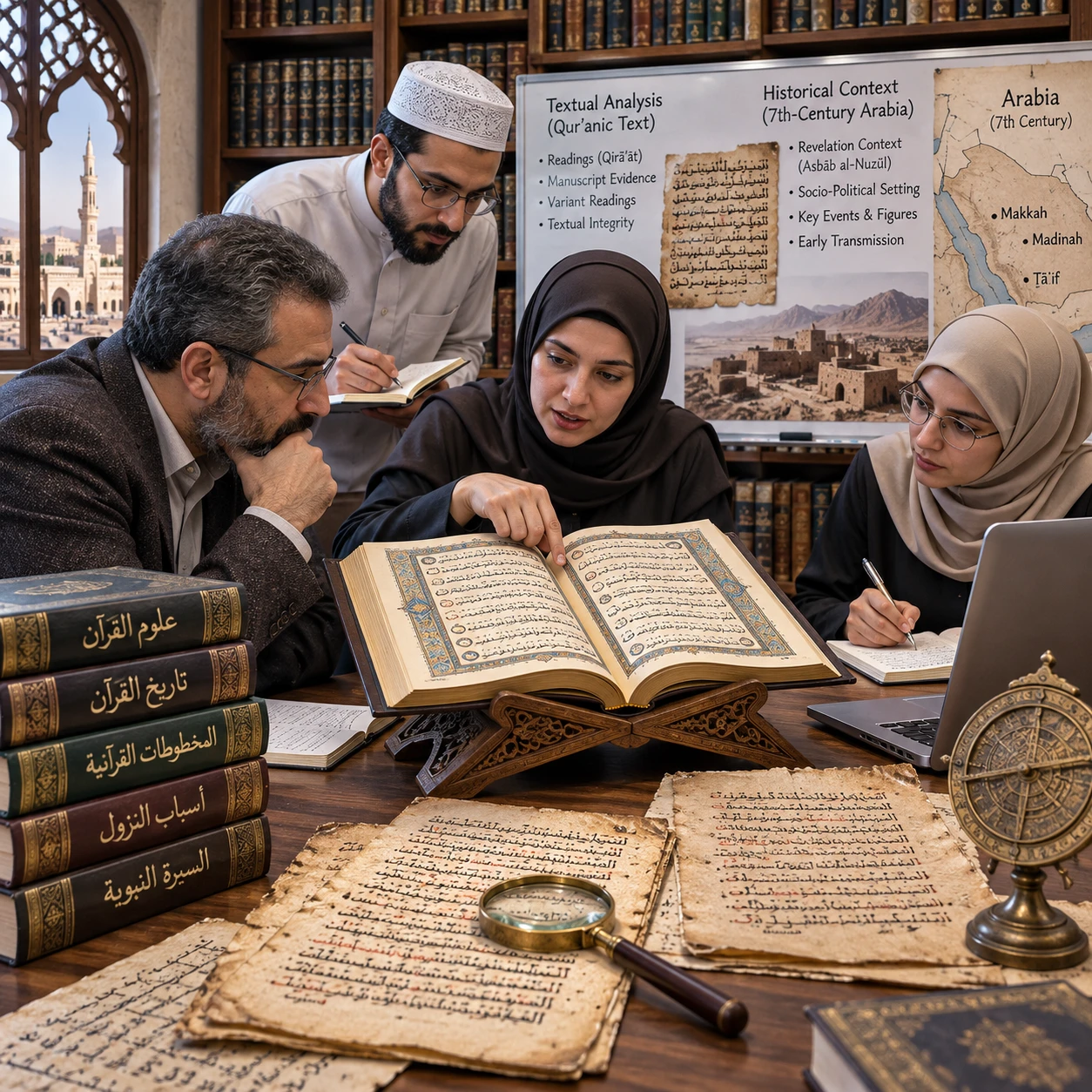
Qur’anic exegesis brings together close reading, transmitted reports, language, and historical inquiry to explain the meanings of the Qur’an. Its methodologies help readers see how interpreters work with evidence, organize discussion, and address questions raised by particular verses or themes.
What Is Tafsir?
Tafsir is the scholarly explanation and interpretation of the Qur’an, using textual, linguistic, historical, and theological evidence to clarify meaning. It is more extensive than a translation or a summary, though translations and summaries can support the study of a passage.
A translation conveys a reading of Qur’anic meaning in another language; it cannot reproduce every feature of the Arabic text or resolve every interpretive question. Tafsir examines those questions: how a word is used, how a verse relates to its surrounding passage, what relevant reports say, and how interpreters have understood its implications. A summary, by contrast, compresses discussion and may leave out the reasoning behind a conclusion.
There is no single format for tafsir. One work may explain the Qur’an verse by verse, while another may focus on a subject such as justice or prophethood. In Islamic studies and Qur’anic research, identifying an interpreter’s method is essential: it shows what kinds of evidence are being used and how the argument is built.
Foundations of Qur’anic Interpretation
Qur’anic interpretation draws on the Qur’an’s internal context, hadith, reports from early Muslim authorities, Arabic language, and historical information such as asbab al-nuzul. These sources help interpreters assess a verse within the text and the setting in which it was understood.
The Qur’an’s own language and cross-references often provide a starting point. A passage may clarify a term or topic addressed elsewhere, while the verses immediately before and after it can shape the sense of a statement. Interpreters also consider Arabic grammar, vocabulary, rhetoric, and patterns of usage. A proposed meaning that ignores the syntax or established usage needs stronger justification.
Hadith and reports attributed to the Prophet Muhammad, his Companions, and other early Muslim authorities can supply explanations, examples, or accounts relevant to a verse. Their value depends on the report and its transmission; a responsible reading distinguishes between the existence of a report and the strength or relevance of its evidence.
Asbab al-nuzul, or occasions of revelation, refers to reports about circumstances associated with the revelation of particular verses. Such reports can illuminate an immediate setting, but they do not automatically limit a verse’s meaning to one event. Researchers weigh them alongside wording, context, and other evidence. The practical question is not simply “What happened?” but “How does this report relate to the verse’s language and scope?”
Major Sources-Based Approaches
Tafsir bi al-ma’thur emphasizes transmitted explanations, while tafsir bi al-ra’y uses disciplined reasoning alongside the textual sources. The distinction concerns the principal basis of interpretation; it does not mean that one approach uses evidence and the other relies on unsupported opinion.
Tafsir bi al-ma’thur
Tafsir bi al-ma’thur, or tradition-based exegesis, gives particular weight to explanations drawn from the Qur’an itself, hadith, and reports from early Muslim authorities. An interpreter might explain an unfamiliar expression by comparing its use elsewhere in the Qur’an, then discuss relevant transmitted explanations. This approach makes the chain of inherited interpretation visible, but each report still requires careful assessment of attribution, context, and fit.
Tafsir bi al-ra’y
Tafsir bi al-ra’y, or reasoned interpretation, applies scholarly judgment to the evidence. It can involve Arabic linguistics, grammar, rhetoric, legal reasoning, theology, and contextual analysis. Here, ra’y does not simply mean a personal preference: a reasoned reading should explain its evidence and remain accountable to the Qur’anic text and relevant sources.
The two approaches can overlap in practice. A commentator may cite early reports and then evaluate their meaning through language or context. The useful distinction is therefore one of emphasis, not a rigid division between tradition and reason.
Common Methods of Organizing Tafsir
Tahlili, ijmali, muqaran, and mawdu‘i are common ways of organizing tafsir. They describe how an interpreter structures the study, rather than whether the primary sources are transmitted or reasoned.
- Tahlili (analytical): Examines the Qur’an verse by verse, often following the order of the text. A tahlili discussion may explain vocabulary, grammar, reports, context, and interpretive questions in detail. Its strength is close attention to individual passages; its challenge is that a reader may need to connect discussions across distant chapters to trace a larger theme.
- Ijmali (concise): Gives a brief, general explanation of a passage or section, usually in textual order. It helps readers grasp the broad sense without extended technical discussion. That brevity is useful for orientation, but it may leave debates over language or reports unexplored.
- Muqaran (comparative): Compares interpretations, verses, or exegetical positions. A study might set two commentators’ readings of a phrase side by side, identify the evidence each uses, and explain where their assumptions differ. Comparison clarifies disagreement, though it requires fair representation and enough context to avoid reducing a position to a slogan.
- Mawdu‘i (thematic): Gathers and studies passages related to a topic across the Qur’an. A researcher investigating mercy, for example, would identify relevant verses, attend to their different contexts, and consider how their meanings relate. Thematic tafsir makes patterns easier to see, but can distort them if verses are detached from their immediate settings.
These methods can be combined. A thematic study may use tahlili close reading for each selected verse, while a comparative project may include concise ijmali explanations before analyzing differences. Naming the method tells readers how the discussion is arranged, not by itself whether its conclusions are persuasive.
How Tafsir Methodologies Shape Interpretation
Tafsir methodologies shape interpretation by determining which evidence receives attention, what questions guide the reading, and how conclusions are organized. Different readings can emerge from the same passage when scholars weigh language, reports, context, or theological assumptions differently.
Consider a verse containing a word with more than one possible sense. A linguistic analysis may focus on grammar and usage; a tradition-centered reading may foreground early explanations; a comparative study may map how commentators differ. Each method reveals something, but none removes the need to justify how evidence supports a conclusion.
Qur’anic hermeneutics examines how interpretation works: the relationship between text, context, interpreter, and community. It helps researchers ask whether a reading accounts for the passage’s wording, surrounding verses, historical evidence, and interpretive framework. This does not make meaning arbitrary. It makes the reasoning behind an interpretation easier to examine.
Two common errors weaken analysis. The first is treating a translation as if it settled every question in the Arabic text; the correction is to consult the wording and explain translation choices. The second is treating an occasion-of-revelation report as the complete meaning of a verse; researchers should assess the report and compare it with the verse’s broader textual context. In both cases, clarity comes from showing the steps between evidence and interpretation.
Contemporary Qur’anic Research
Contemporary Qur’anic research connects established methods with careful historical, linguistic, and comparative study. Strong research identifies its sources, explains its interpretive choices, and distinguishes established evidence from a scholar’s argument.
Researchers may combine close reading with manuscript study, the history of interpretation, or modern questions in Islamic studies. These approaches can widen the evidence under consideration, but they also bring limits: a historical hypothesis, for example, should not be presented as certain when the available evidence is incomplete. The same care applies when using digital databases or translations; they can speed up research, but do not replace source verification.
A transparent study makes its method visible. It identifies which Qur’anic passages it includes, explains how it evaluates hadith and early reports, notes relevant Arabic features, and states how it uses historical context. When comparing classical and contemporary readings, researchers should represent each position in its own terms before assessing its reasoning.
For readers of Islamic studies journals and Qur’anic research, method is more than a label. It is a guide to the evidence and a way to evaluate how an interpretation was reached. A careful account of both sources and organization makes tafsir more accessible without flattening the diversity of scholarly work.
Frequently Asked Questions
What is the difference between tafsir bi al-ma’thur and tafsir bi al-ra’y? Tafsir bi al-ma’thur emphasizes transmitted explanations, while tafsir bi al-ra’y emphasizes reasoned scholarly analysis. In practice, a commentator may use both.
What are the four common methods of tafsir? The four commonly named organizational methods are tahlili (analytical), ijmali (concise), muqaran (comparative), and mawdu‘i (thematic).
How does thematic tafsir differ from analytical tafsir? Mawdu‘i tafsir gathers passages around a subject across the Qur’an. Tahlili tafsir generally proceeds verse by verse, explaining passages in textual order.
Why is context important in Qur’anic exegesis? Context helps establish how a verse relates to its surrounding passage, Qur’anic usage, and relevant historical reports. It reduces the risk of interpreting a phrase in isolation.