Key Scholarly Focuses in Contemporary Islamic Studies

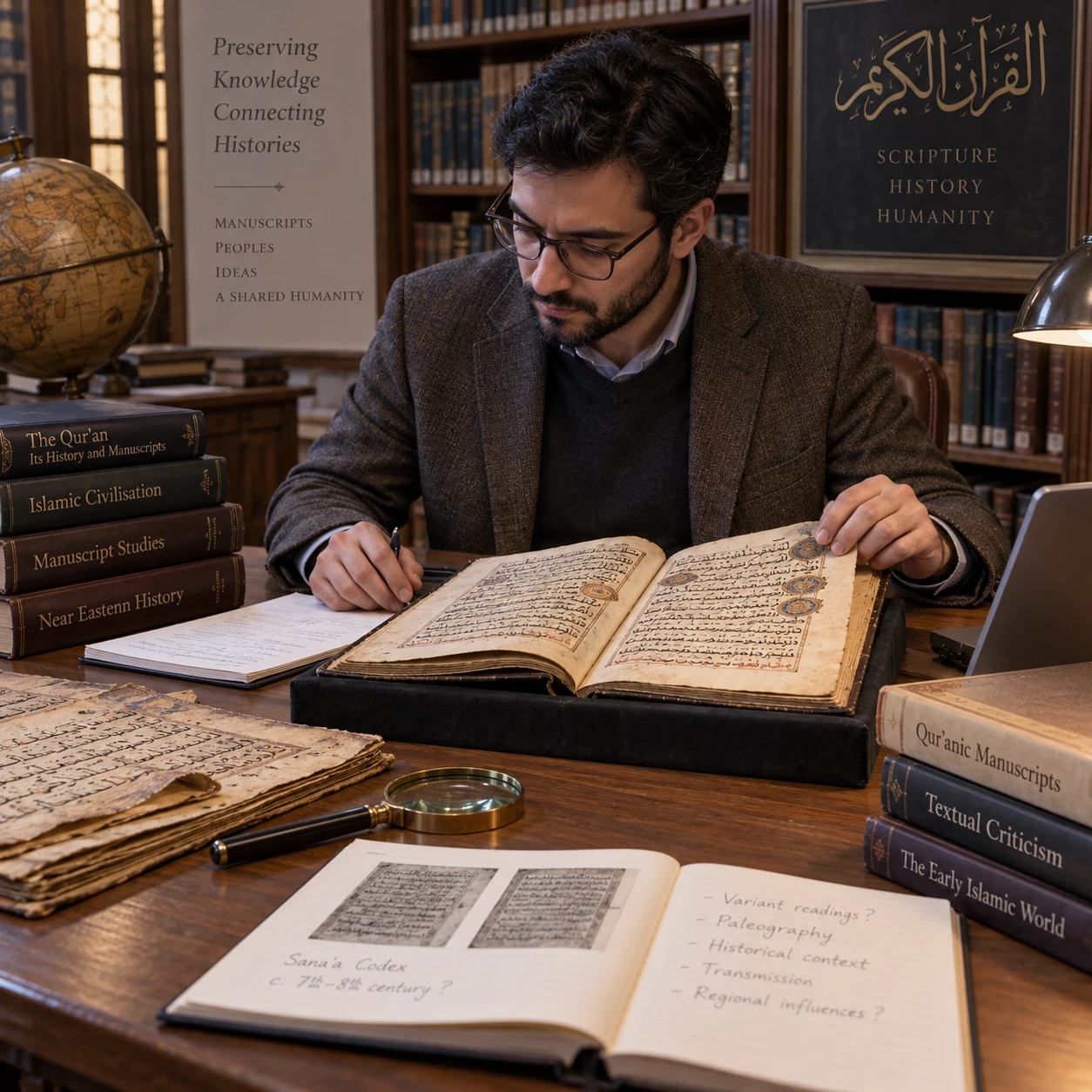
Contemporary Islamic studies examines the texts, histories, ideas, institutions, and lived traditions associated with Muslim societies. Its scholarly focuses range from Qur’anic research and hadith to Islamic law and intellectual history, with researchers using methods suited to different questions rather than relying on a single approach.
For a journal centered on Islamic studies and Qur’anic research, these areas meet around a shared concern: how sources acquired meaning in particular historical settings, and how scholars can explain that process carefully. The result is a field that connects close reading with history and, where useful, with other disciplines.
Defining contemporary Islamic studies
Contemporary Islamic studies is the scholarly investigation of Islam’s texts, traditions, institutions, and histories. It brings religious sources into conversation with historical evidence and the varied ways Muslim communities have interpreted and practiced their traditions.
The field is broad by design. One researcher may study a Qur’anic commentary, while another examines legal reasoning, manuscript circulation, education, or religious authority. These subjects overlap, but they are not interchangeable. Qur’anic studies focuses particularly on the Qur’an’s text, interpretation, transmission, and reception; Islamic studies also includes fields such as hadith studies, fiqh, theology, and social history.
Researchers may approach the same source from different perspectives. A philologist might analyze vocabulary and grammar, while a historian asks when a text was produced and how it circulated. Neither question alone captures every dimension. Strong scholarship states its scope and method, distinguishes evidence from interpretation, and recognizes that Muslim intellectual traditions contain diverse positions.
That distinction matters for readers, too. A study of a historical legal opinion does not automatically describe how all Muslims understand or apply Islamic law today. Academic analysis describes and interprets evidence; it does not need to flatten differences into one account.
Qur’anic research and interpretation
Qur’anic research studies the Qur’an’s language, textual history, interpretation, and reception. Qur’anic interpretation, or tafsir, is central because it shows how readers have explained the text across different periods and scholarly settings.
Questions in Qur’anic studies can begin with a particular passage: What do its words and syntax suggest? How does its structure relate to nearby passages? What historical circumstances have interpreters associated with it? Scholars may compare classical and modern tafsir, trace how a concept changes across commentaries, or investigate how a Qur’anic passage is quoted in another genre.
Textual analysis is essential, but it is only one part of the work. Researchers may examine Arabic grammar, rhetoric, vocabulary, manuscript evidence, and the development of exegetical traditions. They also consider how an interpretation reflects its author’s intellectual environment. A commentary is evidence both for how its writer understood the Qur’an and for the scholarly questions that mattered in that context.
Interpretations can differ, and a contested reading should be presented as contested rather than settled. A careful study identifies the sources it compares, explains the reasoning behind each interpretation, and avoids treating one commentator as a stand-in for the entire tradition. This approach helps connect close reading with the broader history of Qur’anic scholarship.
Hadith, law, and intellectual history
Hadith studies, Islamic law, and Islamic intellectual history help scholars understand how religious knowledge was transmitted, debated, and applied. Together, these fields illuminate the development of Islamic thought and practice without reducing them to a single timeline or school.
Hadith studies investigates reports associated with the Prophet Muhammad, including their transmission, compilation, classification, and interpretation. Researchers may examine chains of transmission, compare versions of a report, or study how scholars used hadith in legal and theological discussions. The choice of method depends on the question: transmission history and later reception are related, but they are not identical.
Fiqh, or Islamic jurisprudence, examines the methods and conclusions through which scholars reason about law. A study of fiqh might compare legal arguments across schools, trace the use of particular sources, or investigate how jurists addressed a specific issue. Historical context can clarify why an argument took shape, while close analysis is needed to represent its logic accurately.
Islamic intellectual history brings these discussions into a wider account of scholars, institutions, genres, and exchanges of ideas. It can connect legal writing with theology, philosophy, education, or political history. The benefit of this wider lens is context; the trade-off is that researchers must avoid implying that every development followed one linear path.
Methods and interdisciplinary approaches
Islamic scholarship uses methods selected for the evidence and research question, including textual analysis, historical study, and interdisciplinary research. Combining approaches can reveal connections that a single method may miss, provided each method is applied with care.
A practical way to plan a project is to move through three questions:
- What is the source? Identify the text, manuscript, commentary, legal work, or other material, and establish what version or edition you are studying.
- What can it show? Distinguish direct evidence from later interpretation. A commentary may document an exegetical argument; it cannot, by itself, establish how every community understood a passage.
- What context is needed? Add historical, linguistic, or social evidence that helps answer the question, without making claims the sources cannot support.
Philology supports precise reading of language, while manuscript studies can clarify how texts were copied and transmitted. Intellectual history situates ideas and scholarly debates over time. Anthropology or sociology may help examine lived practices and institutions, but those disciplines cannot replace textual analysis when the question concerns wording or interpretation.
The main risk in interdisciplinary work is using a method as decoration. A social-scientific claim needs appropriate social evidence; a claim about a text needs attention to the text itself. Researchers also face limits in manuscript access, translation, and the survival of sources. Stating those limits makes findings more trustworthy, not less useful.
Islam in historical and contemporary contexts
Historical and contemporary context helps scholars explain how Islamic traditions show both continuity and change. It situates texts and practices in the settings where they were transmitted, interpreted, and used.
Historical research may consider political institutions, trade, education, language, or the movement of books and scholars. These factors can help explain why a commentary, legal argument, or intellectual debate developed as it did. Context should clarify the evidence rather than act as a shortcut: knowing a period’s politics does not automatically explain an author’s reasoning.
Contemporary research can examine how Muslim scholars and communities engage inherited texts amid modern institutions, technologies, and public debates. It should distinguish a community’s own explanations from an external researcher’s analysis, and avoid presenting one region, denomination, or generation as representative of all Muslims.
The strongest studies make comparisons carefully. They specify which periods, places, texts, or communities are being compared and what the comparison can establish. This precision allows researchers to discuss change without assuming that tradition is static, or that every modern development breaks entirely with the past.
Research priorities for scholars and readers
Useful research priorities include precise questions about Qur’anic texts and interpretation, transparent methods, and clear links between sources and historical context. For readers exploring *Jurnal Suhuf*, these priorities align with an academic scope centered on Islamic studies and Qur’anic research.
A focused project often begins with a manageable problem: how a concept is explained in selected tafsir works, how a hadith report functions in a particular legal discussion, or how a manuscript’s transmission affects the reading of a text. The researcher then identifies relevant primary sources, reviews the scholarship, and explains why the chosen method fits the question.
For scholars and readers, a useful set of checks is:
- Does the study distinguish Qur’anic studies, tafsir, hadith, fiqh, and related fields accurately?
- Does it identify the sources, period, and community it examines?
- Can readers follow how evidence supports the interpretation?
- Does it acknowledge disagreement and limits without overstating its conclusions?
These questions encourage scholarship that is both accessible and rigorous. Contemporary Islamic studies has no single method or final viewpoint; its strength lies in careful inquiry across texts, histories, and traditions. Qur’anic research has a central place in that conversation, while work in hadith, law, and intellectual history helps explain the wider settings in which Islamic knowledge has developed.